
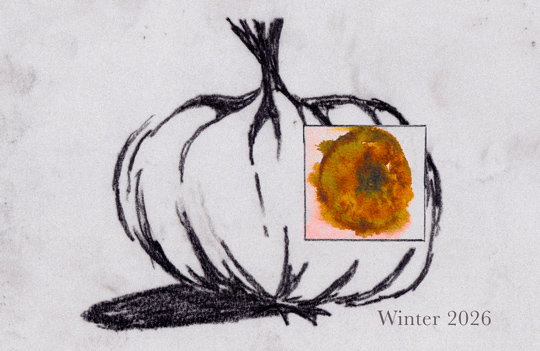
As authoritarianism continues to take hold across the world, writers and translators are compelled to revisit an age-old question: What might art offer in response? Perhaps not answers, but something quieter and more resilient—a reminder of shared human frailty, and of the possibility that our “flow of being,” as Anatoly Loginov writes, might arrive at a “narrow neck” where attention itself becomes an existential force. Writing in our Winter 2026 Issue, which also marks Asymptote’s fifteenth(!) anniversary, Loginov turns to a literary and philosophical tradition that seeks “not mastery over an object, but communion with it, even if that communion burns.” For this second of our two issues devoted to attention, we bring together his tour de force survey of 200 years of Russian thought with a luminous travelogue by the beloved Taiwanese writer Sanmao, an excerpt from Guatemalan author Eduardo Halfon’s prizewinning Tarantula, an exclusive interview with Uzbek novelist Hamid Ismailov, a quietly devastating story by Italian master Dino Buzzati, and new translations of Milo De Angelis by Lawrence Venuti, alongside never-before-published work from 32 countries. All of it is illustrated by our talented Dublin-based guest artist Yosef Phelan.
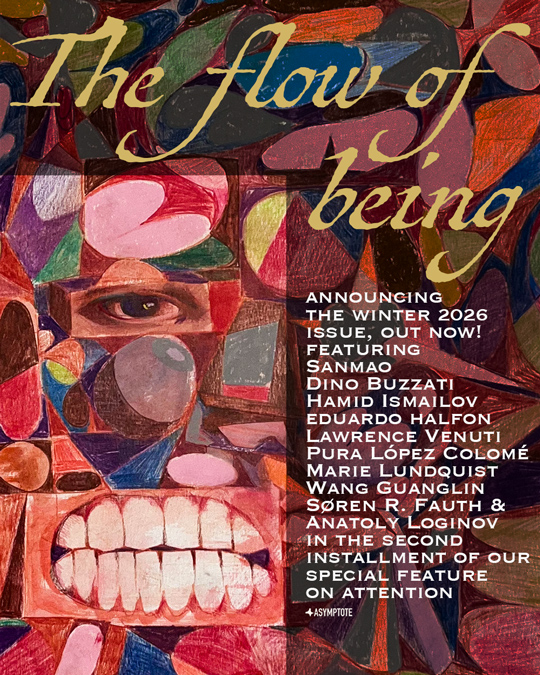
If Loginov argues that attention, when cultivated deeply, can ground compassion toward others, Finnish playwright Minna Canth takes this ethical impulse further into the realm of collective action. In her barnburner drama, railway workers pushed beyond endurance channel their shared anger into defiant sabotage, making exploitation visible at last. Writing from a different frontline, Kurdish journalist Zekine Türkeri bears witness to life in the Mahmur refugee camp in the days preceding an ISIS attack, showing how attention to the living entails the inescapable labor of mourning the dead. Elsewhere, in Egyptian writer Mariam Abd Elaziz’s fiction, characters struggle to care for one another as they swim and sink in the deadly currents of maritime refugee smuggling. The issue’s arc closes with an interview in which China’s Wang Guanglin reflects on the difficulty of imagining a genuinely global literature at a moment marked by isolationism, xenophobia, and resurgent nationalism. World literature, he suggests, remains, at heart, a problem of attention: of who is seen, who is heard, and who is permitted to remain invisible.
For fifteen years, Asymptote has been organized around this problem. Founded on the conviction that literature across languages deserves sustained, serious attention, we have worked to widen the field of vision—introducing readers to voices beyond dominant centers, and treating translation not as a secondary act but as an ethical and imaginative practice in its own right. If this project has mattered to you—if you believe that attention, patiently given, can still resist the forces that would narrow our view—we ask you to help keep it alive by becoming a sustaining or masthead member. Your support ensures that the flow of being we trace here continues to move, freely and exuberantly, into the years ahead.

Blog Editors’ Highlights: Winter 2025
Reviewing the manifold interpretations and curiosities in our Winter 2025 issue.
In a new issue spanning thirty-two countries and twenty languages, the array of literary offers include textual experiments, ever-novel takes on the craft of translation, and profound works that relate to the present moment in both necessary and unexpected ways. Here, our blog editors point to the works that most moved them.
Introducing his translation of Franz Kafka’s The Trial in 2012, Breon Mitchell remarked that with every generation, there seems to be a need for a new translation of so-called classic works of literature. His iteration was radically adherent to the original manuscript of The Trial, which was diligently kept under lock and key until the mid-fifties; by then, it was discovered exactly to what extent Max Brod had rewritten and restructured the original looseleaf pages of Kafka’s original draft. It is clear from Mitchell’s note that he considers this edit, if not an offense to Kafka, an offense to the reader who has lost the opportunity to enact their own radical interpretation of the work: an interpretation that touched Mitchell so deeply, he then endeavored to recreate it for others.
In Asymptote’s Winter 2025 Issue, the (digital) pages are an array of surprising turns of phrase and intriguing structures—of literature that challenges what we believe to be literature, translations that challenge what we believe to be originality, and essays that challenge what we believe to be logic. I am always drawn to the latter: to criticism, and writing about writers. As such, this issue has been a treat.
With the hundredth anniversary of Kafka’s death just in the rearview and the hundredth anniversary of the publication of The Trial looming ever closer, the writer-turned-adjective has not escaped the interest of Asymptote contributors. Italian writer Giorgio Fontana, in Howard Curtis’s tight translation, holds a love for Kafka much like Breon Mitchell. In an excerpt from his book Kafka: A World of Truth, Fontana discusses how we, as readers, repossess the works of Kafka, molding them into something more simplistic or abstract than they are. In a convincing argument, he writes: “The defining characteristic of genius is . . . the possession of a secret that the poet has no ability to express.” READ MORE…
Contributors:- Bella Creel
, - Meghan Racklin
, - Xiao Yue Shan
; Languages: - French
, - German
, - Italian
, - Macedonian
, - Spanish
; Places: - Chile
, - France
, - Italy
, - Macedonia
, - Switzerland
, - Taiwan
, - Turkey
; Writers: - Agustín Fernández Mallo
, - Damion Searls
, - Elsa Gribinski
, - Giorgio Fontana
, - Lidija Dimkovska
, - Sedef Ecer
; Tags: - dystopian thinking
, - identity
, - interpretation
, - nationality
, - painting
, - political commentary
, - revolution
, - the Cypriot Question
, - the Macedonian Question
, - translation
, - visual art
, - Winter 2025 issue
, - world literature